Category: General Insights & Announcements

  • Margin Eaters Revisited: The Hidden Costs of Revenue-Share Property Management and the Inevitability of Flat-Fee PropTech

    Margin Eaters Revisited: The Hidden Costs of Revenue-Share Property Management and the Inevitability of Flat-Fee PropTech

    The modern real estate landscape is awash with technology promising efficiency, scalability, and partnership. Yet, beneath the veneer of progress, a traditional model persists, quietly eroding the hard-earned profits of property operators: rev-share property management. This model, where technology providers take a percentage of rental revenue or management fees, has long been the default. However, a deeper examination reveals that these platforms are not partners in profit, but “Margin Eaters” that stifle true operational scale. The industry is rapidly approaching a tipping point where the flat-fee PropTech model is no longer a luxury—it is an inevitability.

    The Illusion of Partnership: Dissecting Rev-Share’s Hidden Toll

    At first glance, a rev-share property management structure appears fair: the software vendor only succeeds when you do. This “shared risk” narrative is persuasive, particularly to new or smaller operations. But this structure carries a heavy, often opaque, cost burden. The real damage is not just the 10-15% cut of management fees; it is the compounding effect of misaligned incentives and hidden fees that can drain upwards of $10,000 annually from an operator’s bottom line, depending on their portfolio size.

    The first layer of erosion comes from transactional or convenience fees. While the headline might be a revenue split, the fine print often includes processing fees, lease renewal charges, or mandatory markups on maintenance coordination. These hidden costs are often bundled into the platform’s “premium” features, which, for a scaling business, quickly become essential tools rather than optional add-ons. By tying their income to your gross revenue, the platform is incentivized to facilitate more transactions, regardless of whether those transactions are the most cost-efficient or strategically advantageous for the operator.

    Furthermore, the rev-share property management model inadvertently punishes efficiency. Imagine an operator who optimizes their processes, reducing vacancy rates and streamlining tenant onboarding. This efficiency directly translates to increased revenue, leading to a larger dollar-value fee for the rev-share partner, who did nothing to contribute to the operational improvement. In effect, the operator is charged more for being better at their job. This is not a partnership; it is a tax on success.

    Why Existing Platforms Fail the Operator: A Structural Breakdown

    Existing property management platforms built on the revenue-share model fail operators on a fundamental level because they prioritize feature breadth over operational depth and profitability.

    1. The Feature-Shallow Trap: Many established rev-share platforms offer a sprawling suite of features designed to appeal to the widest possible audience. While they may handle accounting, tenant screening, and maintenance, they often lack the deep, customizable automation and integration capabilities that modern operators need to gain a competitive edge. They are jacks-of-all-trades, master of none. The most critical operational bottlenecks—like complex accounting synchronization, dynamic pricing optimization, or hyper-local compliance tracking—are often left untouched or require expensive third-party integrations, further increasing the total cost of ownership (TCO).
    2. Mandatory Upsells and Feature Gatekeeping: A core flaw of the existing platform model is the gatekeeping of critical features. Functionality that should be standard for operational excellence, such as advanced reporting, seamless communication tools, or investor portals, is often locked behind higher subscription tiers or costly “add-ons.” This forces the operator into a constant negotiation between necessity and budget. Unlike a flat-fee model where all necessary tools are provided for a predictable monthly expense, the rev-share structure makes feature access a variable cost, sabotaging the operator’s ability to forecast and control their margins.
    3. Misaligned Incentives: The entire financial architecture of the traditional platform is built on divergent interests. The platform’s goal is to maximize the revenue flowing through its system—not necessarily the profit retained by the operator. For example, a platform might push an operator toward an in-house maintenance network (where the platform takes a small percentage of the service cost) even if a cheaper, local vendor exists. The incentive is volume over value. This subtle, pervasive misalignment is the greatest hidden cost of the rev-share property management relationship.

    The Inevitability of Flat-Fee PropTech

    The structural limitations and margin-eating tendencies of the rev-share property management model are fueling the migration toward flat-fee PropTech. This shift is not merely a preference; it’s an economic necessity driven by three core pillars: transparency, predictability, and operator empowerment.

    1. Total Cost Transparency: Flat-fee platforms simplify the budget. An operator pays a fixed, predictable monthly rate per unit or portfolio, regardless of how high their rental revenue climbs or how many leases they sign. This transparency eliminates the dread of unexpected fees and allows operators to confidently scale their operations knowing their software overhead is fixed. This certainty is vital for financial planning and attracting investor confidence.
    2. Predictability for Scalability: In the flat-fee ecosystem, maximum efficiency is rewarded, not taxed. When an operator invests in training, automation, or optimized workflows that reduce costs or increase rents, every penny of that new margin is retained by their business. The platform remains a constant, reliable expense, allowing the operator to model future growth with accuracy. This certainty is the foundation for aggressive, sustainable expansion.
    3. Operator-Centric Design: New entrants in the PropTech space are designing their platforms around the operator’s profitability, not the software vendor’s revenue stream. This means they are engineered for deep, customizable functionality, prioritizing integrations that save money and features that genuinely streamline complex operations. They provide the complete toolkit necessary for a modern property management operation without the financial gatekeeping inherent in the revenue-share structure.

    Conclusion

    The “Margin Eaters” that dominate the property management software space—the purveyors of the traditional rev-share property management model—are living on borrowed time. As operators become more sophisticated and demand greater financial control, the true, hidden costs of revenue-sharing become untenable. The future of property management belongs to the transparent, predictable, and empowering flat-fee PropTech model. For any operator serious about maximizing margins and achieving scalable, sustainable growth, the time to divest from the illusion of partnership and embrace true operational independence is now

  • The Gov-Con Playbook for Real Estate: 4 Compliance Systems I Learned from Naval Logistics to Flawlessly Vet My Investment Partners.

    The Gov-Con Playbook for Real Estate: 4 Compliance Systems I Learned from Naval Logistics to Flawlessly Vet My Investment Partners.

    In the world of government contracting (Gov-Con), failure is simply not an option. When the stakes involve national security, operational readiness, or multi-billion dollar logistics, the procedures for vetting partners, suppliers, and entire supply chains are not just recommendations—they are mandates backed by decades of proven, high-stakes execution. So, when I transitioned from managing complex defense logistics to navigating the opaque waters of real estate investment, I brought that zero-tolerance mindset with me. The result? A bulletproof playbook for vetting investment partners, built entirely on four critical compliance systems I learned while working with Naval Logistics.

    Real estate investment is often touted as a “people business,” but trust is not a strategy. Every partnership carries counterparty risk, and a bad partner can sink a promising deal faster than a leaky hull. The standard due diligence checklist is a flimsy defense against sophisticated operators or, worse, simple incompetence. Naval Logistics, by contrast, operates on the principle of maximum redundancy and pre-failure analysis. Their rigorous approach to compliance systems ensures that every moving piece—from a single bolt to an entire carrier group—is fully vetted and continually monitored for risk. I adapted this philosophy to create a framework that transforms partner vetting from an art into a repeatable, auditable science.

    Here are the four compliance systems I adapted from the rigorous world of naval operations to flawlessly vet my real estate investment partners:

    System 1: The Material Readiness Vetting Matrix (MRVM)

    In the Navy, “Material Readiness” is the measure of a unit’s ability to perform its mission. It’s not just about what equipment you have, but its operational status and the competency of the crew operating it. I translated this into the Material Readiness Vetting Matrix (MRVM) for real estate. This system moves beyond checking a partner’s past P&Ls; it evaluates their operational capacity. We assign a readiness score based on three vectors:

    1. Procedural Compliance: Do they have documented, repeatable processes for acquisition, management, and disposition? We look for evidence of real Standard Operating Procedures (SOPs), not just promises.
    2. Financial Depth and Reserve: Beyond current assets, what is their stress-test capability? Naval vessels have redundant power and bilge systems; your partner needs redundant capital reserves and defined bailout strategies for unforeseen market shifts.
    3. Team Competency and Certifications: Who are their key personnel, and what is the auditable history of their experience? This is where we verify legal, accounting, and on-the-ground management expertise—treating their qualifications as critical “certifications” that must be continually renewed.

    System 2: The Foreign Object Debris (FOD) Mitigation Protocol

    A tiny piece of debris can bring down a multi-million-dollar jet engine. The Navy’s Foreign Object Debris (FOD) protocol is about meticulous inspection to prevent minor, overlooked issues from causing catastrophic failures. In real estate, the equivalent of FOD is “Hidden Liability Debris”—those small, non-obvious factors that undermine a partner’s viability. This compliance system focuses on an intrusive, deep-dive background check beyond standard criminal and credit checks.

    • Affiliate Mapping: We map every affiliate company, subsidiary, and related party they have worked with in the last ten years, looking for hidden litigation or poorly managed entities that could drag them down.
    • Reputational Deep Scan: We look for patterns of poor communication, strained relationships with past vendors, or unresolved disputes that are not publicly recorded as lawsuits. This is crucial for anticipating friction in long-term projects.
    • Regulatory Flagging: We verify their history of adhering to local zoning, environmental, and tax compliance systems. Any pattern of shortcuts, even minor ones, signals a high-risk personality who prioritizes speed over stability.

    System 3: Continuous In-Service Monitoring (CISM)

    Naval assets are not built, inspected once, and then forgotten. They undergo Continuous In-Service Monitoring (CISM)—constant inspection, diagnostics, and maintenance throughout their lifecycle. This is the antithesis of the “set it and forget it” mentality some real estate investors adopt after closing. As a mandatory compliance system for our partnerships, CISM ensures ongoing alignment and performance.

    1. Monthly Readiness Reports: We demand detailed, non-generic monthly reports on project status, budget burn rate, and deviation from the original pro forma. These reports must be auditable back to source documents.
    2. Scheduled Stress Tests: Annually, we conduct a joint stress test on the partnership’s financial model, simulating sudden market downturns or unexpected repair costs. This forces proactive risk mitigation discussions.
    3. Conflict of Interest Audits: We periodically review new investments or businesses undertaken by the partner to ensure there are no emerging conflicts of interest that could divert their focus or resources from our joint venture.

    System 4: Post-Mission Failure Analysis (PMFA)

    When a naval operation encounters a setback, a Post-Mission Failure Analysis (PMFA) is mandatory. It’s a ruthless, non-punitive review designed to extract lessons and update protocols. This is perhaps the most unconventional, yet vital, compliance system for vetting partners. While you are vetting them now, you must also understand how they handled failure in the past.

    • The ‘Scars’ Interview: We don’t just ask about successes; we demand a detailed account of their biggest failures. How did they communicate the failure? What was the financial damage? More importantly, what specific, documented changes did they implement afterward?
    • Lesson Learned Integration: A partner who cannot articulate specific, integrated “lessons learned” from a prior failure is a liability waiting to repeat the mistake. We vet their current SOPs to see if those painful lessons were actually incorporated.

    By adopting these four compliance systems—the MRVM, FOD Mitigation, CISM, and PMFA—I have created a due diligence process that is far more robust than anything typically seen in commercial real estate. You are no longer relying on hope or a handshake; you are relying on auditable readiness, preemptive risk identification, continuous oversight, and evidence of adaptive capacity. If you want to build a truly resilient investment portfolio, stop thinking like an investor and start thinking like a logistics commander. Your bottom line will thank you for the military-grade precision.

  • Ground-Up Construction vs. Value-Add: The Truth About Depreciation and ROI in Purpose Built Co-Living

    Ground-Up Construction vs. Value-Add: The Truth About Depreciation and ROI in Purpose Built Co-Living

    The modern housing crisis demands a systems-driven solution, and for the savvy capital allocator, that solution is co-living. But a foundational decision separates those who build high-yield, scalable ecosystems from those who inherit risk: the choice between Value-Add renovation and Ground-Up construction. This is not merely a preference for old versus new; it is a critical calculation of risk mitigation, operational efficiency, and, most importantly, financial leverage through depreciation and long-term Return on Investment (ROI).

    For the Real Estate Architect, the goal is compliance, scalability, and predictable high yield. When we apply this rigor, the truth about Ground-Up construction of purpose built co-living assets becomes undeniable.

    The Illusion of Value-Add: Inheriting Risk

    The Value-Add model is tempting. It involves acquiring an existing, often distressed, property—frequently a large single-family home (SFR) or a small multifamily building—and retrofitting it for co-living use. The initial barriers to entry are lower, and the timeline can be faster. However, this strategy is inherently flawed for institutional-grade investing.

    • Suboptimal Layouts: Traditional housing layouts are not designed for high-density, shared living. Retrofitting often results in inefficient circulation, undersized common areas, and a lower-than-optimal bedroom count per square foot. This immediately caps your potential top-line revenue.
    • Hidden Capital Expenditure (CapEx): An old asset is an asset with deferred maintenance. While you may have a renovation budget, unforeseen issues—from foundation problems to outdated plumbing and non-compliant electrical systems—quickly erode projected returns and introduce significant schedule delays. Value-Add is not about building a system; it’s about fighting an existing, inefficient one.
    • Zoning and Compliance Friction: Converting an existing structure to a higher-density use often involves a protracted, unpredictable battle with local planning departments. If the final structure is not a purpose built co-living asset, it can be perpetually non-compliant, exposing the investor to unnecessary legal risk.

    The Financial Architecture of Ground-Up: Maximizing Depreciation

    Ground-Up construction, while requiring a larger initial capital outlay and a longer construction timeline, unlocks a powerful financial lever that Value-Add simply cannot touch: accelerated depreciation. This is the truth that dramatically shifts the ROI equation for capital allocators.

    In real estate investment, the ability to generate paper losses via depreciation to offset passive income is the ultimate tax shield. Traditional depreciation allocates the structural cost over 27.5 or 39 years. However, new construction allows for comprehensive Cost Segregation, a method where a specialized engineer breaks down the property’s cost into components with shorter depreciation lives:

    • 5- and 7-Year Assets: Movable furniture, appliances, carpeting, and specific site improvements.
    • 15-Year Assets: Land improvements like fences, driveways, parking, and landscaping.

    Because a brand-new purpose built co-living structure is entirely composed of new components, you maximize the immediate, accelerated write-offs. You create substantial paper losses in years 1-5, often shielding the entire investment’s initial cash flow from taxation. Value-Add projects, by contrast, rely on the remaining depreciable life of the original, older structure, severely limiting this powerful tax benefit. Ground-Up doesn’t just build a home; it builds a superior tax structure.

    ROI: Scalability, Systems, and Predictable Yield

    Beyond the tax benefits, Ground-Up construction creates a foundation for predictable, high-yield ROI by solving operational friction before it starts. Our approach—building 10-bedroom, 3-story infill co-living assets—is a scalable blueprint designed for cash flow.

    1. 1. Optimized Revenue Per Square Foot: A purpose built co-living asset is designed to maximize the ratio of private suite space (high revenue) to common area space (necessary overhead). This is impossible to achieve when constrained by the walls of an existing single-family home.
    2. 2. Reduced CapEx and Operational Cost: New construction means lower utility costs, fewer emergency repairs, and virtually no deferred maintenance risk for the first decade. This is crucial for maintaining the asset’s Net Operating Income (NOI). Every dollar saved on maintenance is a dollar that drops straight to the bottom line, enhancing ROI.
    3. 3. PropTech Integration and Automation: A new build allows for the seamless integration of systems like Kaipo’s PropTech platform, CoRent. We design the network, access control, and smart home technology from the first drawing, eliminating costly retrofits and maximizing the efficiency of property management. This systems-driven approach bypasses the typical 15.5% revenue cuts of competitor platforms, further boosting investor yield.
    4. 4. Investor Scalability: The consistency of a Ground-Up prototype allows Kaipo to offer fractional investors access to a reliable model. When every Houston asset follows the same 10-bedroom floor plan and the same underwriting model, it becomes an institutional-grade, de-risked investment vehicle—which is the primary goal for our Real Estate Development Clubs.

    The Architect’s Choice

    Value-Add is a strategy of compromise; Ground-Up is a strategy of mastery. If you are building wealth and seeking to establish a compliant, scalable, and high-yield real estate portfolio, the choice must be the superior financial and architectural model. Ground-Up construction, specifically for purpose built co-living, maximizes immediate tax benefits through accelerated depreciation and ensures long-term, predictable ROI through system design and operational efficiency. We are not just buying real estate; we are engineering superior housing solutions.

    Join The 20/20 Co-Living Development Club and view the anatomy of a fractional deal.

  • The Systems-Driven Real Estate Architect

    The Systems-Driven Real Estate Architect

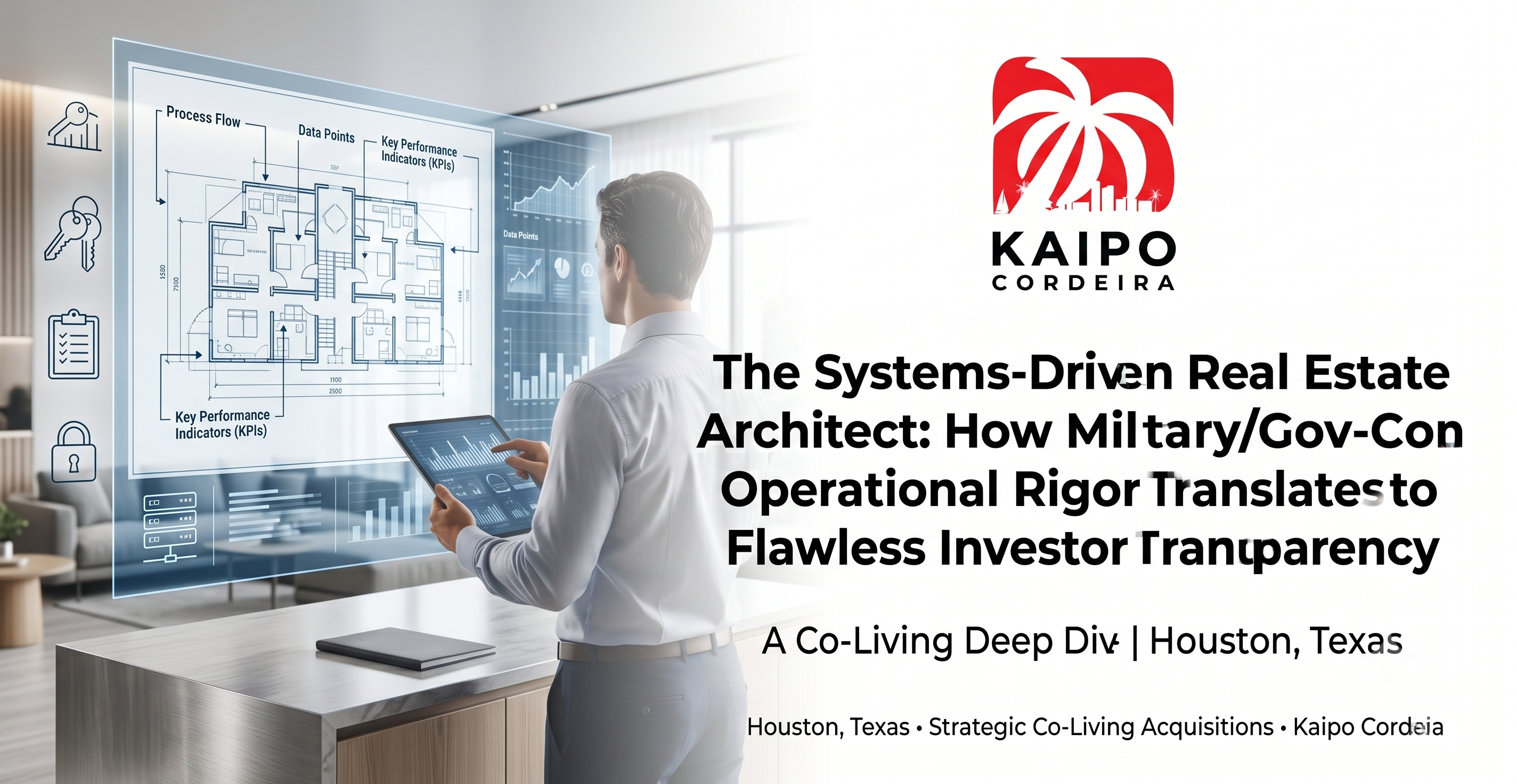
    How Military/Gov-Con Operational Rigor Translates to Flawless Investor Transparency

    Aloha, everyone. My journey didn’t start in a plush corporate boardroom or a high-rise office. It started in the shipyards of Hawaii—with a toolbelt, grit, and blue-collar roots. In those yards, I learned that results are built, not found. Later, managing high-stakes government contracts and maritime logistics taught me a level of operational rigor that most real estate investors never see. Today, as a Serial Entrepreneur, I’m translating that exact same military-grade precision into a real estate ecosystem designed for one thing: investor transparency.

    In the world of government contracting (Gov-Con), there is no room for “maybe.” You either meet the compliance standards, or you’re out. When I transitioned into scaling a real estate portfolio, I noticed a massive gap in the industry. Traditional real estate is often locked behind gatekeepers and vague projections. I saw a housing crisis that needed a solution and a working class that needed a trusted on-ramp to wealth. My mission became clear: to democratize real estate by bridging the gap between traditional capital and emerging market opportunities, all while maintaining the highest level of investor transparency.

    The Blueprint: Precision Meets Property

    At Kaipo Capital, we don’t just buy buildings; we architect ventures. We focus on niche, high-yield asset classes like co-living, mobile home parks, and RV parks—sectors that provide steady demand and resilience in any market cycle. But the asset is only half the story. The other half is the system behind it.

    Scaling a real estate portfolio requires more than just hustle; it requires a roadmap. That’s why we’ve implemented the Entrepreneurial Operating System (EOS). By using business systems like EOS, we move from being mere “operators” to Venture Architects. This systems-driven approach ensures that our construction project management is flawless and that every dollar of capital is accounted for. For our equity partners, this translates to investor transparency that is institutional-grade yet approachable.

    Addressing the Housing Crisis with Aloha

    “Investing with Aloha” is more than just a catchphrase; it’s our “Profit with Purpose” model. We are tackling the national affordable housing crisis by creating innovative solutions like co-living semesters and purpose-built 10-bedroom housing ecosystems. These aren’t just flips; they are scalable assets designed for working families and savvy capital allocators alike.

    We believe that private investment is the most powerful tool for social change. By optimizing properties for high yields while keeping them affordable for the modern workforce, we achieve a “Double Bottom Line.” We are building wealth for our investors while creating dignified, affordable homes for our communities.

    The On-Ramp to Passive Wealth

    Whether you are a non-accredited investor looking to self-direct a retirement account or a seasoned professional seeking stable passive income, we provide a safe and trusted partnership. We underwrite conservatively—no sales hype, just math. Our process is simple: Discover, Explore, and Invest.

    Real estate shouldn’t be a closed club. By pooling resources through syndication, we allow everyday investors to access institutional-grade deals that were previously out of reach. And because of our systems-driven foundation, you can invest and relax, knowing that investor transparency is baked into our DNA.

    Mahalo for being part of this journey. Let’s build something that lasts—together.

    CTA: My brand-new personal site is coming soon at hvcfp7f8cw.wpdns.site. In the meantime, explore our current opportunities and download our “Investor 101” guide at kaipocapital.com.

  • Serial Entrepreneurship in Capital Investing: Solving the Housing Crisis with Co-Living

    In the fast-paced world of 2026, where digital trends shift in a heartbeat and market volatility is the new constant, investors are increasingly asking one critical question: Where can I put my capital that it will be truly protected?

    My journey didn’t start in a boardroom; it began in the shipyards of Hawaii. Back then, I learned that the most valuable things are those you can touch, build, and repair with your own two hands. Today, as a Serial Entrepreneur, that same “blue-collar grit” informs every investment decision I make. While the allure of high-speed digital assets is real, 2026 has proven that tangible assets—real, physical property—are the ultimate foundation for long-term wealth.

    Here is why tangible assets are winning in today’s economy and why they remain the cornerstone of the Kaipo Cordeira brand.

    The Security of “Intrinsic Value”

    The primary reason tangible assets win is simple: they have intrinsic value. Unlike a stock that can drop to zero based on a bad earnings report or a digital currency that can vanish in a liquidity crisis, real estate is tied to the land. Whether it’s a mobile home park, a co-living space, or a new construction project, these are physical assets that serve a fundamental human need: shelter.

    In 2026, as interest rates fluctuate and global markets remain unpredictable, having your capital anchored in property provides a “liquidity moat.” This is a defensive mechanism that ensures the asset retains value even when the broader market freezes. You aren’t just buying a ticker symbol; you’re buying a piece of the world.

    Predictable Cash Flow in an Unpredictable World

    We believe your money should work for you, not the other way around. Tangible assets, particularly in the residential sector, are cash-flow machines.

    At Kaipo Capital, we maintain a singular, high-performance focus on Co-Living Housing as our primary asset class.

    By maximizing the use of space in high-demand urban areas like Tampa or Houston, we generate significantly higher rental yields than traditional single-family rentals while providing essential housing solutions.

    In an era of uncertainty, the predictable monthly income generated by these assets allows investors to “hang 10” and enjoy financial freedom while their money works in the background.

    Addressing the Housing Crisis with “Aloha”

    Investing with heart means more than just looking at a spreadsheet; it means making an impact. The U.S. is currently facing an unprecedented housing affordability crisis. By investing in tangible assets like workforce housing and co-living communities, we aren’t just building portfolios—we’re building solutions.

    “Serial Entrepreneurship” is about turning vision into a tangible reality. When we reposition a 5-bedroom home in Tampa into a 10-bedroom co-living asset, we are creating five new affordable beds for the workforce. This social impact creates a “double bottom line”: strong financial returns for our investors and high-quality, dignified living options for underserved communities.

    Tax Advantages and Appreciation

    Finally, tangible assets win because the math is simply better. Real estate offers tax advantages that most traditional investments can’t touch. From depreciation to 1031 exchanges, these tools allow you to keep more of what you earn. Furthermore, while cash flow pays the bills today, long-term appreciation builds the generational wealth of tomorrow. Physical assets in growth markets like Phoenix and Hawaii are primed for steady appreciation as population growth continues to outpace supply.

    Conclusion: Build Your Future on Solid Ground

    The “old way” was trading your time for money and hoping the stock market would be kind to your retirement account. The “Kaipo Cordeira way” is about building wealth with hustle and heart. It’s about leveraging the security, cash flow, and impact of tangible assets to create a life of freedom.

    Our new personal brand site is coming soon to hvcfp7f8cw.wpdns.site, where we will dive deeper into these strategies. Until then, stay grounded, invest with purpose, and remember that the best returns are built, not found.


  • From Blue Collar to Capital Builder: The Journey of a Serial Entrepreneur

    My journey didn’t start in a boardroom or behind a desk; it began with a toolbelt and the salt air of Hawaii. Growing up, I learned the true meaning of hard work in the shipyards, performing hands-on ship repairs and contracting. Those blue-collar roots provided more than just a living; they built a foundation of grit and a deep appreciation for the effort it takes to earn a dollar.

    I took that same shipyard work ethic into the world of real estate. I started with my boots on the ground, working through fix-and-flips and new construction projects. I saw firsthand how tangible assets like land and property could provide security and growth that traditional stocks often couldn’t match. But as I scaled my portfolio to over seven successful deals and raised more than $1 million from my network, I realized my mission was bigger than just personal success.

    Today, I operate as a Serial Entrepreneur. To me, “Serial Entrepreneur” is the intersection of institutional-grade professional execution and real-world, street-smart experience. It’s about building wealth not just with systems and math, but with “Aloha”—a commitment to trust, transparency, and hear

    We focus on asset classes like mobile home parks, RV parks, and co-living spaces because they address a real need: the affordable housing crisis. By pooling resources through syndication, we give everyday investors—the business owners and shipyard workers I grew up with—a seat at the table to build their own financial freedom.

    This isn’t just about the numbers on a spreadsheet; it’s about a movement to democratize real estate and lift communities up. We build with process, not just promises, ensuring that every project is a bridge to a more secure future for our investors and the neighborhoods we serve.